Posted on

Turning disadvantage on its head

Good work, good people, good cycles

Good Cycles’ employment model starts unlocking talent by overcoming employment barriers. We help people access transport to get to work, build professional experience, gain qualifications or certifications, and expand their professional and community networks. 

For people with atypical abilities, high caring responsibilities, or a lack of local networks, this can be the difference between persistent insecurity or building a career path. 

A win-win partnership

This month, two of our employees made big steps towards their chosen career paths by working on a project with DM Roads. This company has been a dedicated partner to Good Cycles’ social mission and we have been committed to meeting DM Roads skills needs. It’s a win-win partnership that creates opportunity as it creates business efficiencies.

Good Cycles doubled DM Roads bridge inspection teams by pairing our employees with their experienced inspectors. The project provided training in a way that accelerated the overall work rate and provided valuable experience to employees building their skills and networks. 

A freeway gantry in Melbourne.
Gantries are inspected as part of the project


‘This is the skill set I wanted to develop – to plan, schedule and communicate project objectives. It is my first job in the field that I have studied so it means a lot’

– Ankit


Teams checked the integrity and safety of bridges and gantries around the transport network. As well as finishing the work ahead of time, Good Cycles employees gained industry-relevant experience, made important professional connections and made a mark with their attitude, teamwork and problem-solving. 

A Truck Mounted Attenuator (TMA) keeps the work team safe


‘I really appreciated the way they arranged meetings with contacts and potential employers on my behalf, as well as offering a great reference’

-Nathan


Without a hand up, the new work opportunities and respected references these two young people have gained would have been out of reach. They earned them, but they may never have had the chance without pathways that let them show what they can do.

Thanks for your support.

Posted on

All you need to know about converting to tubeless tyres

Tubeless tyres are what they say on the package in that they’re tyres that don’t have an old school tube inside to keep it up. Rather than a tube, the tyre makes an almost airtight seal with the rim to keep the air in.

To make that airtight seal work the rim needs:

  • special rim tape that is a very tight fit on the rim;
  • a valve that looks like the valve on a Presta tube but with a rubber bung on the inside to seal with the rim tape;
  • and finally, some tubeless sealant to fill up any remaining small holes between the tyre, rim and valve. Tubeless sealant is a milky liquid with small particles of latex or other materials that seal small holes.
Tubeless essentials: Sealant, rim tape and valves
Left: Tubeless sealant. Top right: Rim tape. Bottom right: Tubeless valve.

So what do you need to fit tubeless tyres to your bike? 

  1. Tubeless compatible rims (or wheels). On these rims the bead hook where the tyre connects is made to ‘lock’ the tyre into it as there is no pressure from a tube pushing the tyre against the rim to keep the tyre in place. We do not recommend setting up non-tubeless rims as tubeless because the tyre can blow off! You can tell if your wheels are tubeless compatible by looking at the stickers on the side of the rim. They should say something like “Tubeless ready” “Tubeless Compatible” or there will be an acronym like ‘TLD’ or ‘TCS’ indicating they are tubeless.
  2. Tubeless tyres. Like rims, the bead of a tubeless tyre is made to ‘lock’ into the rim. Tubeless tyres need to be made more accurately than standard tyres hence they are more expensive. Tubeless tyres are always folding. As with rims, don’t set normal tyres up as tubeless even on tubeless rims.
    Tubeless tyres with markings “TLC” (Tubeless Compatible) and”TR” (Tubeless Ready) all meaning these tyres will work tubeless.
    Tubeless tyres. Note the markings “TLC” (Tubeless Compatible) and”TR” (Tubeless Ready) all meaning these tyres will work tubeless.

  3. Tubeless rim tape. Tubeless rim tape is thinner, stretchier and tighter fitting than normal cloth rim tape. You need at least two wraps of tubeless rim tape to seal the rim. Some rims even come pre-taped with rim tape.
  4. Tubeless valves. These look like someone has cut a Presta valve out of a tube.
  5. Tubeless sealant. A milky mix to seal up the remaining holes.
  6. A tubeless pump, compressor or high volume pump. To inflate tubeless tyres a large and quick volume of air is needed to pop the tyre onto the tubeless bead and ‘lock’ it in place – you’ll often hear bangs and pops when this happens. A normal floor pump can sometimes do it but is much easier with a tubeless specific pump as it includes a chamber to ‘pre-charge’.
Rim cross sections
Rim cross sections

Why would you want to go tubeless?

  1. No more pinch flats! Without a tube to squeeze between the rim and tyre pinch flats become a thing of the past.
  2. You can run much lower pressures safely due to not having to worry about pinch flats. This is especially useful for mountain bikes, gravel bikes and cyclocross bikes.
  3. Small punctures are sealed by the tubeless sealant. If a small puncture occurs the pressure inside the tyre pushes the sealant into the hole and the small particles clog the hole and seal it up. Some pressure will be lost but typically you won’t need to put a tube in.

Why would you not go tubeless?

  1. It can be a bit messy especially if you get a flat bad enough that you need to put a tube in. Yes, if the puncture is big and bad enough that the sealant doesn’t plug it a tube can be put in the tyre but you have to deal with the mess of the sealant.
  2. It’s more expensive. Even though you aren’t buying tubes so often, sealant, tape and the more expensive tyres more than make up for it.
  3. Tubeless tyres are typically ‘performance’ tyres. It’s hard to get tough commuter tyres so tubeless tyres don’t tend to last as long.
  4. Simplicity. Fixing a flat tube is straight forward! 

If you have any other questions about tubeless tyres or want us to set your wheels up as tubeless give us a call, send us an email or drop in and have a chat.

Posted on

Knowles Tivendale

Knowles has over 20 years’ experience on strategic planning and transport integration projects for public sector organisations and government departments. He works collaboratively with clients and stakeholders to achieve his vision of developing integrated, efficient and sustainable public transport solutions.

In his twelve years as a consultant, and previous ten years in local government, he has led multidisciplinary teams on complex projects including: researching and producing integrated transport plans, strategic frameworks, business cases and options assessments; evaluating transport networks including financial and economic modelling; developing transport network improvement strategies focussed on delivering enhanced customer value to the wider community; and policy development with a focus on creating cities that are vibrant, efficient, productive, sustainable and resilient.

Knowles currently also lectures on transport, mobility and traffic systems at Monash University and La Trobe University (Bendigo). He is also the President of Dandenong Primary School Council.

Posted on

Jonathan Ayres

Jonathan brings over 20 years of experience in investment management and private client focused roles to Good Cycles. He is currently Managing Partner at Australia’s largest independent private wealth advisory firm, Koda Capital, and has run private client business across BT/Westpac and NAB/MLC.

Posted on

Emily Synnott

Emily is a proven leader, collaborator and specialist in social impact and social innovation. With over 17 years’ experience working across consulting, government and the for-purpose sector in Australia and the United Kingdom, she has held several senior roles in systems change and social policy. Her key areas of expertise are in social and sustainable procurement, young people, civil justice systems, future workforces and enabling employment. Emily is currently the Senior Manager, Social and Economic Impact at Development Victoria.

Posted on

Rim brakes or disc brakes – what’s the difference?

It’s a given that we see a lot of bikes in our shop and we’ve noticed that more and more modern bikes are being equipped with disc brakes. While once reserved for mountain bikes, disc brakes are now appearing on flat bar commuter and road bikes. So which is best? Rim brakes or disc brakes?

Let’s take a look at the pros and cons of disc brakes.

Disc brake
Disc brake

The pros:

  1. Better stopping power, especially in wet weather. Disc brakes are almost always more powerful than a similar quality level of rim brakes. This is more evident in the wet when rubber rim brakes don’t grab onto the braking surface of a rim as well as disc brake pads grab a rotor.
  2. The braking surface is kept away from mud and dirt. This is important with mountain bikes when you ride off-road, as debris gets on the rims and negatively affects braking.
  3. Your rims don’t wear out! As disc brakes don’t touch the rim you will never need to replace the rims due to wear from the brake pads. Every time a rubber rim brake pad makes contact with the rim it wears a very small amount of material off. Over time you slowly wear your rims away.
  4. No braking surface on the rims frees up wheel and rim designers to make rims and wheels that are strong and aerodynamic without any braking considerations.
  5. Braking power is tunable by changing the rotor size (the bigger the rotor the more power).
  6. Less hand strength is needed to brake compared to rim brakes, particularly true of hydraulic disc brakes.

The cons:

  1. They’re typically more expensive than rim brakes.
  2. They’re heavier than rim brakes. Disc brake frames are strengthened to withstand the braking force from disc brakes, which is what makes them heavier.
  3. They’re harder to work on. Particularly hydraulic disc brakes which need the fluid replaced periodically.
  4. Aesthetics. It’s hard to argue that disc brakes look better than a classic road rim brake.
  5. Rim brakes typically have better modulation. While disc brakes have more power, rim brakes tend to have more modulation. This refers to the ‘feathering’ of the brakes, the speed modulation, basically when you want to slow down for a corner rather than come to a hard stop or slow down a lot.
  6. Disc brakes can be noisier, especially if the pads get contaminated. Contamination occurs when grease or oil gets on the disc brake pads. The only solution to this problem is to replace the pads and clean the disc brake rotor thoroughly, so keep your chain lube away from your disc brakes!
Rim brake
Rim brake

In our opinion disc brakes are worth equipping on bikes over $1000. Particularly for a commuter, mountain or gravel bike. The exceptions are road bikes that won’t see any wet weather, such as your “nice weekend road bike”. For that style of bike rim brakes are fine, as the bike will weigh less and road bikes have so little rubber on the road that disc brakes can be overkill. The limiting factor in braking is the tyres traction, so with little rubber making contact on the road, you’ll just end up skidding (which can be fun!).

Thinking of changing your brakes? We’ve got parts for both systems here.

Posted on

Wheels of View – a Youth Week initiative

Good Cycles’ supported employees have been using photos to express themselves and reflect on their day to day experiences of work. Using digital platforms was already part of the job, but using the smartphone for creative expression to explore professional identity was something new. 

We affectionately called this effort “Wheels of View”. It wouldn’t have happened without the vision and drive of Belinda Woodruff and all the supported employees who brought it to life. The project was made possible by funding by the Victorian Government for Youth Week.

Through the power of photography, young people shared their perspectives and feelings that were tied to the image. Some of the submissions were astounding! Clearly, everyone’s engagement with work is personal, and connecting with it reveals the hidden gems. 

The intention was to host an exhibition of the collection of photos during Youth Week to showcase all of the incredible images. However, Covid put a pause on that idea. 

Being a team that isn’t easily disheartened, we had another idea. We collaborated with Jacinta Cubis to create an online workshop and interactive exhibition. 

Youth week participants
Supported workers practice speaking confidently about themselves and their work.

The purpose was to use the photos to help supported employees get more comfortable talking about their work. What they enjoy about it, what it gives to them, what they learn, and try to use those ideas in response to the question: ‘What do you do?’ It’s a question you hear everywhere –   from a party to meeting a new team member. And sometimes your response might open up new opportunities: especially at a networking event or job interview.

Some of the highlights for participants from the experience of taking the photos and reflecting on  them with peers were incredibly uplifting as they discussed the significance to their lives of:

  • Traveling to parts of Melbourne they have never seen before
  • Developing new hobbies
  • Working together with nature
  • Bike riding allowing them to enjoy the journey in between jobs
  • Learning that cycling is the best way to discover Melbourne

Overall, it was a great experience that saw participants come out of their shells and speak confidently about their photos and themselves. We value the contribution of every supported employee but it was great to see and hear what young people value for themselves. 

Maybe in the future, we will be able to hold the exhibition and do it all in person.

You can view all of the photos here.

Posted on

Electronic vs mechanical gear systems

Electronic gear system

Let’s take a look at gear systems. Specifically, the difference between electronic vs mechanical gear systems.

The “Big Three” bike part manufacturers each have an electronic gearing system:

  • Shimano has Di2 for both road and mountain bikes;
  • Campagnolo has EPS; and 
  • SRAM has Etap which, along with being electronic is wireless! 
Left: Electronic rear derailleur (Shimano Dura-Ace R9150 Di2). Right: Mechanical rear derailleur (Shimano Tourney RD-TY500), note the electric wire going into the electronic derailleur vs the steel cables into the mechanical model.

There are, of course, the pros and cons of electronic gear shifting. 

The pros:

  1. No cables to stretch, rust or replace.
  2. Cable routing isn’t an issue, whereas mechanical cables don’t like to go around sharp curves, but digital wires can go anywhere. This frees up bike designers to make frames and handlebars weird and wonderful, which is especially evident in aerodynamic time trial and triathlon bikes.
  3. The shifting is done by a servo motor actuated derailleur rather than a cable actuated derailleur. This means electronic groupsets can cope with ‘heavy’ shifts and weird chainring combos better than mechanical groupsets. For example, sometimes when you’re on a steep climb (like Arthur’s Seat or Devil’s Elbow) where it’s more difficult to move to an easier gear under strain.
  4. There’s less hand strength needed to shift gears, which is great for people with smaller hands or arthritis.
Left: Electronic shifter (Shimano Dura Ace R9170, Di2). Right: Mechanical shifter (Shimano Acera 7 Speed ST EF500)

The cons:

  1. There is a battery to keep charged (or several if you have SRAM E-tap). If your battery goes flat the system automatically shifts you into the smallest chainring and the smallest cog on the cassette.
  2. It’s expensive. Typically electronic drivetrain parts cost 2.5x or more than the mechanical equivalent.
  3. The feedback from the shifters isn’t the same, think typing on a touch screen vs typing on a proper keyboard where the tactile feedback from the keyboard makes typing easier. This is especially true when wearing gloves.
The battery does need to be kept charged and in this case, is done via a USB charger.

Both systems are affected by chain and cassette wear as well as the derailleur hanger being straight and aligned correctly. So, regardless of which system you run, it does need servicing!

If your bike is due for a service you can book in at 1 of our 3 hubs, Monday to Friday.

Posted on

Good Cycles and Event Studios Australia team up

Event Studios Australia (ESA) hit end of year targets and created a job opportunity for a young person in a win-win for productivity and social impact. Unemployment and underemployment disproportionately affect young people so together ESA and Good Cycles are addressing a significant unmet need for entry-level jobs.

Entry-level jobs build professional skills and experience and availability has been eroding for a decade. More so in the pandemic conditions of 2020. Without them, young people facing multiple disadvantages in the labour market are at higher risk of economic and social exclusion.

ESA and Good Cycles joined up to provide work for young people who have been hit hard by the pandemic. ESA Director, Jamie O’Connor, and Good Cycles employee, Beau, hit it off immediately.

‘The way Jamie gives direction shows the care he takes with every job and every person. All the instructions he gives are clear and the work is very organised. He leads by example with a professional and kind workplace culture’ said Beau.

And James had equally positive things to say of Beau ‘Just letting you know that Beau did really well today. Very diligent and took instruction well. He was very thorough in his painting. Also kept the site extremely clean, looked after the paint/brushes and most importantly wanted to stay busy at all times… All key things ESA pride ourselves on.’

Smart job-carving, so that young people can contribute at their level, builds futures and prevents inequalities from becoming entrenched. The ESA-Good Cycles’ approach values young people and gives them every chance to succeed. They gain industry experience and build their resumes with every job. 

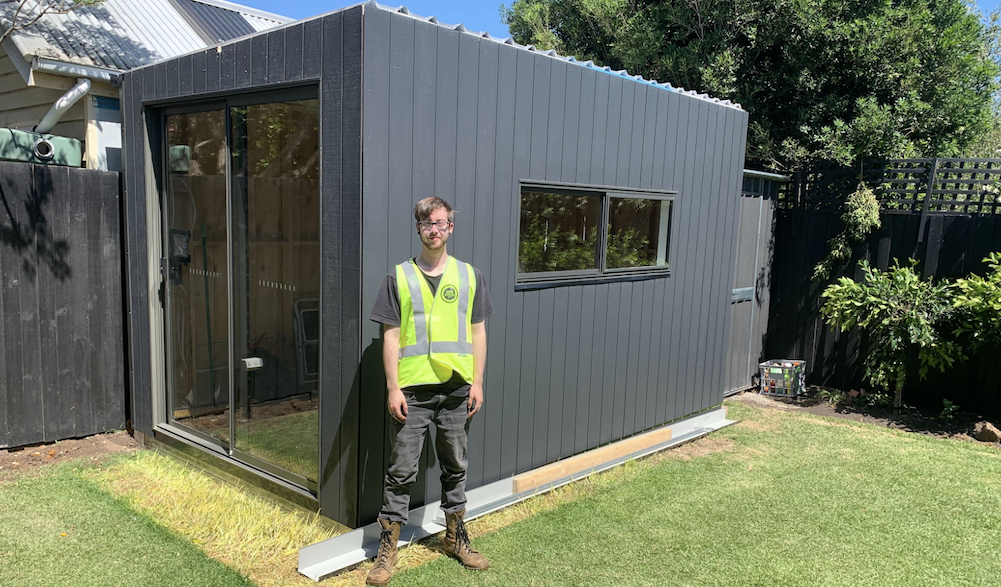
So far Beau has had the opportunity to work on a backyard office pod, which saw him take on the following: 

  • Liquid nails on all the timber prior to the cladding
  • Full Sand of the structure with an orbital sander
  • Roll and brush three coats of paint, externally
  • Final Touch-up with a fine brush (all the grooves in the wood)
  • Full Internal painting and light sanding
  • See a 2 tonne cabin moved into position with load skates and crowbars

Job done.

Posted on

What Khalid did with your support in 2020

In a year with so many surprises, Khalid’s story shows how Good Cycles and our supporters stopped people from falling through the cracks. Most of all, Khalid’s story shows what young people can do when given the chance to contribute.

The Huddle recommended Khalid for supported employment at Good Cycles. Here was a young man who had always made the most of opportunities and yet opportunities were hard to come by. 

He had studied hard, worked hard, won student of the year; but a lot of people didn’t understand the three cultural influences shaping Khalid’s identity. And because many people prefer what is familiar, Khalid’s chances of employment were being limited.

As a young Muslim, African and Australian man, Khalid didn’t have the luxury of just representing one culture, one community, one society. Fitting in with some of his community often meant feeling like an outsider to others. 

Khalid arrived at Good Cycles ready to take on any role. He learned the Toyota Kaizen method we use to keep car-share fleets clean and serviceable all over Melbourne. But when our partner, CityWide, requested an administrative officer we knew this would give Khalid a chance to use some of his other skills and build his professional connections. 

The new role went well. It became a full-time job and Khalid was loving it. Then the pandemic hit. CityWide had to downsize and the job was gone. 

Because of the close relationship between CityWide and Good Cycles we knew Khalid had been left vulnerable. We consulted the community and local government partners and identified a new opportunity. It couldn’t have been more suited to Khalid if it was designed for him.

Agencies across the City of Melbourne wanted to understand young people’s experiences of job services and hear what that journey was like for those of African origins. With an Advanced Diploma and Bachelor in Media and Communications, Khalid had the knowledge required to tell these stories in a compelling way. As a multilingual person of East African origins himself, Khalid knew how to engage the community. 

Khalid’s 12 case studies for Youth Pathways informed a round table of agencies and social enterprises and the City of Melbourne. Meanwhile, his own geographic and religious community was in a severe pandemic lockdown and COVID-19 was taking a toll on family and friends. 

As another short term job came to an end, Khalid saw that the need it had been addressing was as pressing as ever, even if the project was ending. His community of Muslim, African Australians was not well understood by the services that had been involved in managing the pandemic, and their stories were not being told.

Khalid with his camera
Image credit: Kushitic Productions

Kushitic Productions was born. From Street Team member at Good Cycles to Small Business Owner, Khalid’s journey is one of the triumphs of 2020. Good Cycles and our partners worked hard to make sure Khalid wasn’t left to fall through the cracks, but Khalid’s own skill, persistence and vision shaped his success. 

Get on the journey with us and support Khalid’s business by checking out his services and sharing with your networks. Or use his content to start your own journey towards a better understanding of the East African people from which Kushitic Productions takes its name. Let’s all get more familiar with each other’s diversity and appreciate the value it contributes to our communities.

Posted on

The Youth Pathways ‘In Our Own Words’ project

Youth Pathways In Our Own Words Participant

Good Cycles program participants have recently shared perspectives about the difference Good Cycles has made in their lives  through the Youth Pathways project. Youth Pathways is a collaborative initiative sponsored by the City of Melbourne to facilitate innovation between youth-focused local organisations such as Good Cycles  about how best to support opportunities for young people.

The recent ‘In our Own words’ project sought to know more about the impact of partnerships and collaborations in successfully delivering impactful outcomes for program participants. Good Cycles’ Yasin, S’moe and Ali shared their insights and experiences:

Yasin’s Story:


S’moe’s Story:


Ali’s Story:

Posted on — Leave a comment

Keeping Melbourne’s shared user paths safe!

Good Cycles has partnered with DM Roads to improve Melbourne’s shared user pathways for everyone!

After pedestrians expressed safety concerns over the use of utes to undertake shared user paths (SUPs) inspections along the Hume, Western and Metropolitan Ring road Freeways, DM Roads contacted Good Cycles to see if we could undertake this work with a safer alternative: bikes!

Following thorough training from DM Roads on hazard and defect identification, our team began inspections in November 2019.

Since then, our inspections have evolved to incorporate a ‘find and fix’ approach, allowing us to assist DM Roads by filling small cracks and gaps in the paths, fixing street signs and removing graffiti, as we go along inspecting the paths. This approach creates efficiencies and increases productivity for DM Roads.

We’re excited to provide an innovative service that meets both business needs and broader environmental needs, replacing large inspection vehicles with a bike to reduce carbon emissions and impact on vegetation.

This work also provides supported employment for young people, such as Nathan (pictured above), facing barriers to entering the workplace or sustaining a secure connection to work.

Good Cycles is proud to partner with DM Roads to offer safer and more environmentally friendly solutions to SUPs inspections.

To find out how Good Cycles can provide environmentally-friendly maintenance and logistics services for your organisation, please contact us here.

Posted on

Eve’s Story

“The Pedal Empowerment Program (PEP) allowed me to slowly get back into the routine of having a weekly commitment after several years of unemployment, and meant that instead of relying purely on a CV and interview I was able to introduce myself to people over a few weeks and demonstrate my skills and eagerness to learn.

“Regular interview approaches had been difficult for me due to both ADHD, and the fact many interviews I’ve had placed more focus on me explaining my gender, health status, or intermittent past employment than what I can actually contribute.

“After the Pedal Empowerment program I was offered a transitional employment role that acknowledged my obstacles and let me build confidence, fitness and stability at my own pace. The ongoing support offered was unconditional – they understood my hesitance to trust an employer, and lack of confidence in some areas of work, and built that trust and confidence over time. I wasn’t pushed into unsustainable rosters or expectations.

“I’ve learned that I can enjoy work and actually look forward to my day rather than just persisting for the sake of income and stability. I appreciate being given autonomy and being trusted to work on tasks independently, being given a variety of physical and mental tasks, and being in a workplace which is accommodating of people’s challenges and differences.

“The financial stability I’ve gained through regular work has allowed me to dramatically improve my own life. I am now able to afford to access the health care I need, have a secure and comfortable living situation, and have been able to support my partners and friends when they need it.

“I heard about PEP through another participant, and it came with a strong recommendation. I wish more young people were hearing about it, and similar programs, from their Job Service Provider or other employment service.”